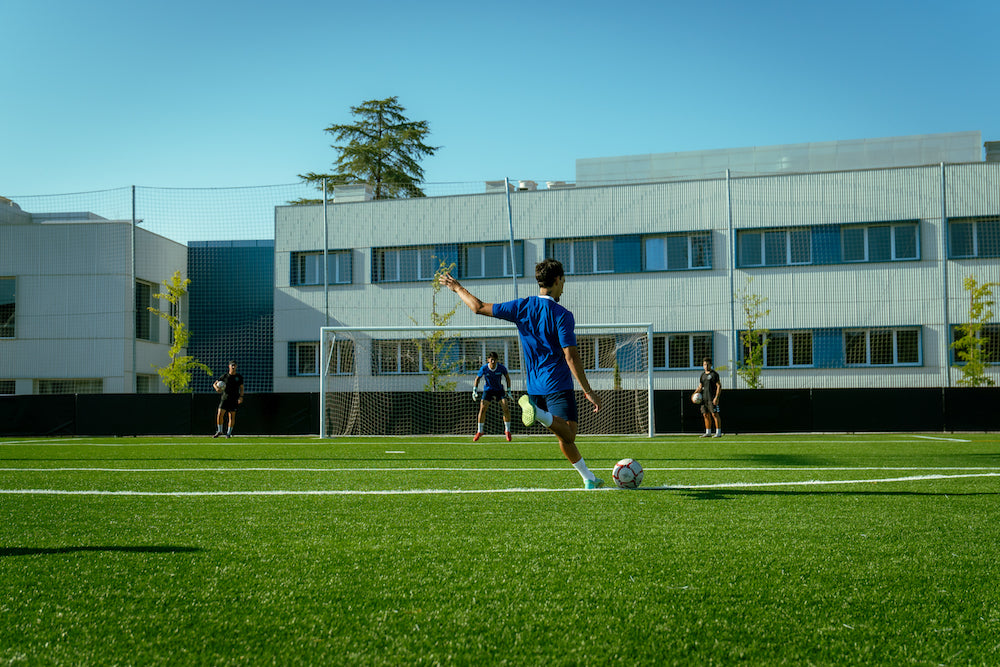


What is the best position in soccer? There is no one answer that fits every player. The best position for a young player is usually the role that helps them contribute, learn, and enjoy the game while continuing to build a broad set of skills. A player's fit can change with age, experience, teammates, and the demands of a match.
Explore GFI Academy's Competitive program
What does “best position” really mean?
Families often ask for the best position because they want a clear way to help a player succeed. But soccer positions are not a ranking from most important to least important. Each role solves different problems for the team. A goalkeeper protects the goal and starts play. Defenders prevent opponents from advancing and help build attacks. Midfielders connect different parts of the field. Forwards create chances and pressure the opposing defense.
Even within those broad groups, roles differ. A central midfielder may need to receive under pressure and distribute the ball. A wide player may need to recognize space near the sideline and deliver a pass or cross. A center forward may link play, make runs behind defenders, or hold the ball for teammates. Coaches can adjust duties to a team's shape and the players available.
So instead of asking which position is objectively best, ask which role gives this player useful challenges and chances to contribute right now. The answer should account for the player's current skills, what they are learning, and what the team needs—not only goals, size, or a favorite professional player.
How do the main soccer positions differ?
The following comparison is a starting point, not a rulebook. Players need overlapping abilities. For example, defenders need to pass and make decisions, while attackers must defend when possession changes.
| Role | Common responsibilities | Skills a player can develop | Useful fit clues |
|---|---|---|---|
| Goalkeeper | Protect the goal, communicate, and help restart attacks | Positioning, handling, decision-making, communication | Enjoys focused responsibility and reading play; interested in goalkeeper-specific work |
| Defender | Protect space, challenge for the ball, and support the team's buildup | Awareness, timing, one-on-one defending, passing | Enjoys anticipating danger and making dependable choices |
| Midfielder | Connect defense and attack, support teammates, and manage possession | Scanning, receiving, passing, movement, stamina | Enjoys being involved in many phases and finding solutions under pressure |
| Forward | Create scoring chances, make runs, combine with teammates, and press | Finishing, movement, close control, decision-making | Enjoys attacking spaces, creating chances, and responding quickly near goal |
These are tendencies, not strict requirements. A forward still needs to track back and combine. A defender may start attacks with a progressive pass. Strong teams benefit when players understand how the roles connect.
Why should young players explore more than one role?
Trying different positions can help a young player see the game from more than one angle. A player who has defended may better understand when an attacker is likely to turn. A player who has played in midfield may notice the support a teammate needs after winning the ball. That perspective can build awareness and communication across the team.
Exploration also gives coaches more information. A player may discover a role they enjoy, or reveal a strength that was less visible in another position. Comfort can grow with practice. A player who feels uncertain in a new role may simply need time to learn its decisions and responsibilities.
That does not mean every player must rotate constantly. A team may have practical needs, and players may have preferences. The goal is to avoid treating an early assignment as a permanent label. Development is a process; positions can remain flexible as physical, technical, tactical, and personal qualities grow.
How can families notice a promising fit?
Watch for signs of engagement and learning, rather than choosing a position based on one game or a single statistic. Consider:
- What catches the player's attention? Do they enjoy organizing teammates, finding passing options, taking on defenders, or protecting the goal?
- Which decisions are becoming more natural? Notice whether the player scans, moves to support, recognizes danger, or times runs effectively.
- Where do they want more practice? A player's curiosity and willingness to work on a challenge can matter as much as current performance.
- How do they respond to mistakes? Look for a chance to learn and reset, not a reason to define their ability.
- Does the role fit the team's needs? Individual development happens within a group, and different match situations call for different contributions.
Ask the player open questions after a match: What part felt enjoyable? When did you feel involved? What would you like to try next time? These questions let young athletes reflect without making every conversation about evaluation.
Does speed, size, or scoring decide a player's position?
No single physical trait decides a player's future role. Speed can help in many areas, but players also use timing, balance, vision, technique, communication, and judgment. A taller player is not automatically a center back or goalkeeper. A player who scores often is not limited to playing forward.
Physical development varies, especially during childhood and adolescence. Coaches should consider the whole player and avoid making long-term decisions from a temporary difference in growth or maturity. Technical and tactical understanding can continue to develop across positions. A broad foundation gives a player more ways to contribute as the game changes.
Research on youth elite soccer reports that activity profiles differ by position, including running and sprinting distances, but those findings describe group patterns rather than prescribe a position for an individual child. The study of activity profiles by position in youth elite soccer is useful context, not a tryout test or a measure of which role is best.
How can a player learn a position without getting stuck in it?
Learning a role means understanding its decisions, not just standing in a designated part of the field. A player can develop position-specific awareness while continuing to practice transferable skills such as first touch, passing, receiving, movement, and communication.
- Learn the role's main question. A defender might ask, “Where is the danger, and who can I support?” A midfielder might ask, “Where is the next useful passing option?” A forward might ask, “How can I create space or a chance?”
- Practice decisions in game-like situations. Small-sided activities can give players repeated opportunities to see choices and respond. The purpose is learning, not forcing a single solution.
- Review moments, not labels. After a session, discuss one decision that worked and one situation to keep practicing. Avoid turning an error into a verdict about a player's suitability.
- Keep communication open. Players can tell coaches what they enjoy and where they feel challenged. Coaches can explain what the team needs and what the player is learning.
GFI Academy describes its player-centered methodology as developing technical, tactical, physical, cognitive, and personal qualities. Families can learn more about the GFI Academy methodology and the program pathway overview to understand how development can extend beyond a single position.
How do age and experience affect position choices?
For a newer or younger player, enjoyment, confidence, and basic familiarity with the game matter. Players benefit from opportunities to touch the ball, make decisions, and learn core skills. A position can offer a helpful structure, but it should not limit a child's chance to participate in different parts of play.
As players gain experience, coaches can introduce more detailed role responsibilities and tactical choices. Competitive players may encounter specific team systems, opponents, and match plans. Even then, a role is not a guarantee of future placement. Players can grow into new responsibilities, and a team's needs may change from season to season.
For older players considering high-performance or college-bound pathways, role clarity can become more important because teams and evaluators consider how a player contributes within a particular system. Still, versatility and the ability to understand the full game remain valuable. Families should ask coaches how role-specific work fits into the wider development plan.
How should parents talk with a coach about position fit?
Choose a calm time outside the immediate emotions of a match. Be specific and curious. Instead of asking, “Why isn't my child a striker?” ask what the coach wants the player to learn in the current role and what signs would indicate readiness for another challenge.
- What are the main responsibilities of this position for our team's system?
- Which strengths is my player using here, and what skill should they work on next?
- Are there opportunities to experience another role during training or a future match?
- How can we support the same learning goal at home without over-coaching?
- What should we pay attention to over the next few weeks?
These questions keep the conversation focused on development and make room for the coach's view of team needs. They also help the player hear a consistent message: a position is a place to learn and contribute, not a permanent judgment of talent.
How can families compare soccer programs and development fit?
Position coaching is only one part of a player's experience. Consider the age group, level of commitment, coaching approach, location, and the family's goals. GFI Academy serves Greater Houston families through Recreation, Competitive, and High Performance pathways, with training locations across The Woodlands, Grand Oaks, Central Houston, and Sugar Land.
When comparing options, ask how the program balances technical foundations, tactical understanding, physical development, and personal growth. Ask how coaches communicate role expectations and how a player can raise questions. Families can review the Competitive program, explore Recreation soccer, or see the GFI Academy locations to identify a relevant next step.
For girls interested in specific competitive pathways, learn about DPL soccer and GA Aspire. For boys, ask about the applicable MLS NEXT pathway. The right fit depends on the player's age, readiness, interests, and the team's current opportunities; a program page or position label cannot make that decision on its own.
GFI Academy's tryouts information can help families explore competitive opportunities. For a broader look at the environment, the GFI Performance Center and facilities page provides additional context.
Frequently asked questions
What is the easiest soccer position to learn?
There is no universally easiest position. The learning curve depends on the player's experience, coaching, and the role's responsibilities. Starting with clear, manageable decisions and supportive instruction is more helpful than choosing a position based on a general ranking.
Which position scores the most goals?
Forwards often have many chances to finish attacks, but goals can come from players in every role. Scoring totals also depend on the team's style, opportunities, and match circumstances, so they do not determine a player's best position.
Can a player change positions?
Yes. Players can try new roles as they develop and as team needs change. Familiarity in one position can help, but it does not mean a player must stay there forever.
Should parents ask for a specific position?
Parents can share what their player enjoys and ask the coach about learning goals. It is usually more productive to discuss responsibilities, feedback, and opportunities than to insist on a particular position.
What should your family take away?
The best position in soccer is the one that offers a player a meaningful way to contribute and a useful challenge at this stage—not a label that limits what they can become. Keep the conversation centered on learning, enjoyment, and the player's complete development, and revisit role fit as experience grows.
Explore competitive tryout information
Give your player room to learn the game from different angles, and work with coaches to find the next step that fits.