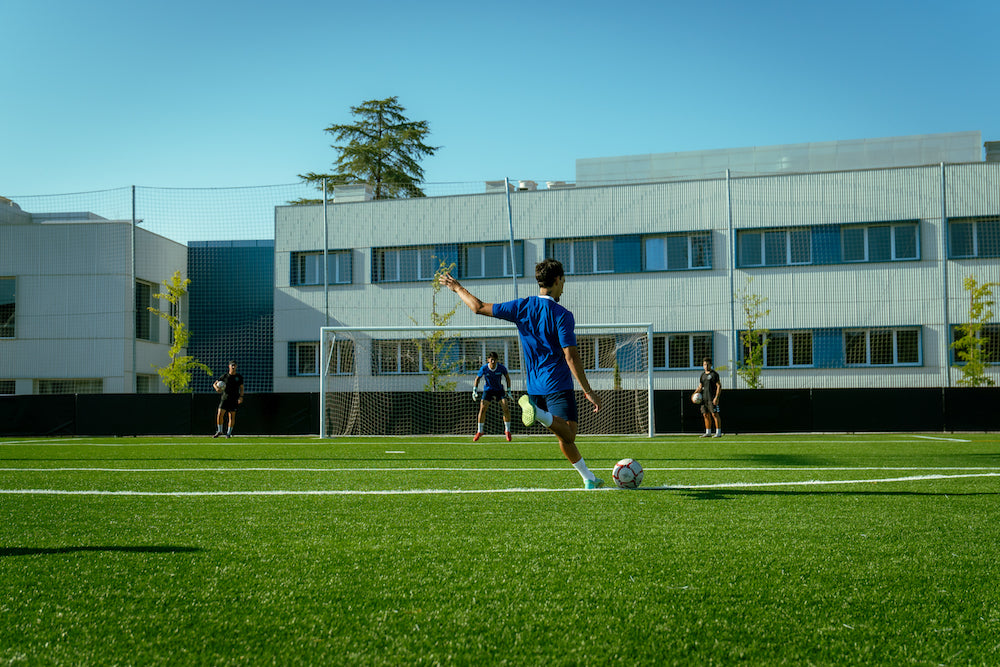


Good defending is more than winning the ball. Youth players learn to read the attacker, stay balanced, protect space, and work with teammates. These soccer defense drills give families and coaches practical ways to develop those habits, from simple footwork to pressure and cover in small-sided play. Keep the emphasis on decisions and safe technique, not on a promise that one drill will produce a particular result.
Ask GFI Academy about player development
What should youth players learn when defending?
A defender is solving a changing problem. Where is the ball? Which way can the attacker go? Is a teammate close enough to provide cover? What space matters most right now? A useful practice activity gives players repeated chances to notice those details and choose a response.
Individual defending starts with a balanced stance and controlled movement. In a group, players add pressure, cover, and communication. The aim is not to teach every player to charge forward or to stand still. It is to help them recognize when to close down, when to slow the attacker, and when to protect a teammate or space.
Research on elite soccer has examined how teams use different attacking and defensive styles of play, a reminder that defending involves coordinated choices as well as individual actions (analysis of defensive and attacking styles in soccer). For young players, coaches can introduce those ideas through manageable, game-like situations and age-appropriate challenges.
How can you set up a useful defending practice?
Start with a clear, small task. Use a ball, a safe playing area, and enough space for players to move without colliding. Explain one or two cues, demonstrate them, then let players try. Pause briefly to ask what they noticed. Avoid long lectures that leave children waiting instead of playing.
For younger or newer players, make the area larger, reduce the speed, and begin with a predictable attacker. As players gain experience, introduce direction, a goal to protect, a teammate who can cover, or a transition after the ball changes hands. Change one feature at a time so players can understand the challenge.
Which soccer defense drills build footwork and balance?
1. Mirror movement
Pair players a few steps apart. One player leads with slow side steps, small forward movements, or a change of direction; the defender mirrors without crossing their feet or turning their back. Switch roles after a short round. Begin without a ball so the defender can focus on posture and balance, then let the leader carry a ball at a walking pace.
Prompt the defender to stay light on their feet, keep their body between the attacker and the space to protect, and adjust rather than lunge. Keep the leader's movements controlled, especially with younger players. The purpose is to practice tracking and changing direction, not to trick or collide with a partner.
2. Side-step through gates
Set two or three pairs of small cone gates in a line. A defender moves laterally through each gate, stays square to a partner or coach, and returns to the start under control. The partner can point to the next gate or signal a direction. Once the pattern feels comfortable, add a ball for the attacker to carry at a steady pace.
Use short rounds and rest between them. This activity is a simple way to notice whether a player can change direction while keeping a stable stance. It is not a race. If a player begins crossing their feet, losing balance, or moving too quickly to control their body, slow the pace or widen the gates.
3. Approach, slow down, and contain
Place an attacker with a ball several steps from a marked line. The defender starts farther away, closes the space under control, then slows down before reaching the attacker. The attacker tries to dribble across the line; the defender aims to stay between the attacker and the line and guide the play away from it. Switch roles often.
Teach the defender to shorten steps as they arrive instead of sprinting right up to the ball. Ask the attacker to move at a pace that lets both players keep control. Start with a wide area and a clear boundary. Make the space narrower only when players can move safely and understand the goal.
How do players practice pressure without diving in?
4. Channel the dribbler
Create a lane with cones and a small target at one end. The attacker tries to dribble through the target, while the defender tries to delay the run or guide the attacker toward one side of the lane. The defender's task is to stay balanced and make the route harder, not to poke at every touch. After each turn, ask which direction the defender tried to show.
Begin with a broad lane and a predictable attacker. Later, allow the attacker to choose either side or add a second target. This helps defenders connect body position to a purpose: taking away a dangerous route and buying time for a teammate to help.
5. One-on-one to a line or goal
Set up a small area with an attacker, a defender, and a line or mini-goal to protect. The attacker attempts to score or dribble over the line. The defender works to stay goal-side, close space at a controlled pace, and respond to the attacker's movement. Use brief turns so players switch roles and stay engaged.
At first, make the defender's success simply slowing the attacker or forcing a change of direction. Do not reward risky contact. As players become more confident, add a clear way to restart after the ball leaves the area. Keep the challenge fair: if one player repeatedly dominates, adjust the space, starting distance, or roles.
6. Recovering defender
Start with an attacker and defender moving toward a target, while a second defender begins a few steps behind. On a signal, the trailing player recovers toward the goal side of the attacker. The front defender delays the dribble long enough for the recovering player to get back into the play. Rotate positions after each short repetition.
This drill teaches urgency with control. The recovering player should choose a route that helps protect the target, rather than sprinting directly into the attacker. Keep the starting gap modest, and do not add more speed until players can see one another and move without unsafe contact.
How can drills teach cover and communication?
7. Pressure and cover in pairs
Use one attacker with a ball and two defenders. One defender moves toward the attacker to apply pressure; the other stays a few steps behind and to the side, ready to help if the attacker gets past. The attacker can dribble toward a target or choose between two gates. After each round, switch which defender pressures and which provides cover.
Ask the pair to name their jobs before the repetition: who is closest to the ball, and who is protecting the space behind? Keep the distance between defenders close enough for help but not so close that one turn takes both out of the play. Adjust the spacing based on age and comfort.
8. Three-player defend-the-gates
Mark two gates at one end of a small area. Two attackers try to pass or dribble through either gate while three defenders work together to protect them. The nearest defender pressures the ball; teammates cover useful space and communicate. If three defenders make the task too easy, use two. If attackers struggle to find a route, widen the area or add time.
After a short round, ask the defending group what changed when the ball moved from one attacker to the other. Encourage simple, clear calls such as identifying who is going to the ball and who is covering. The purpose is coordinated decision-making, not memorizing a rigid formation.
9. Defend a small goal, then transition
Play two attackers against two defenders toward a small goal. When defenders win possession, they try to dribble or pass through a counter gate at the other end. This gives defenders a reason to stay composed after regaining the ball and helps all players experience the switch from defending to attacking.
Keep the area suitable for the players' age and ability. A large area gives more time to make decisions; a smaller one increases pressure. Use a clear restart after a goal or ball out of bounds. Praise good recovery, communication, and responsible choices even when the defending team does not win the ball.
10. Numbers-up recovery game
Play a short game in which one side begins with an extra attacker moving toward a target. A defender who starts behind the play must recover when the coach or a teammate calls a signal. The defenders first work to delay and protect the central route; once the recovering player arrives, they can try to regain possession together. Rotate who starts behind.
Use this only when players can already manage a basic one-on-one. Reduce the advantage, distance, or pace if the situation becomes chaotic. The drill should help players recognize a temporary disadvantage and cooperate, not make a young defender feel responsible for an impossible situation.
How should you progress these drills by age and experience?
There is no single pace that fits every child of the same age. Use the player's comfort, attention, movement control, and experience to choose a starting point. Short rounds, frequent role changes, and a simple goal help younger players stay involved. Older or more experienced players can handle more choices, but the activity should still have a clear purpose.
| Player stage | Useful starting challenge | Progress when ready | Keep in mind |
|---|---|---|---|
| Newer or younger | Mirror movement, gates, slow approach with no pressure to tackle | Add a ball, a wide target, or a predictable attacker | Use short turns, simple cues, and generous space |
| Developing game awareness | One-on-one channel, line defense, recovering defender | Add a second target or a supporting defender | Change one rule at a time and rotate roles |
| Experienced competitive player | Pressure-and-cover pairs and small-sided transition games | Add choices, direction changes, or a numbers-up recovery | Keep decisions game-like; do not rely on speed alone |
These are flexible starting points, not age cutoffs. If players cannot explain the task or move safely, simplify it. If they solve it easily, add one new decision. A coach can also connect an activity to the player's current development goals rather than trying to cover every defending idea in one practice.
How can you combine the drills in one practice?
A simple practice can move from individual movement to a shared game problem. Begin with mirror movement or side-step gates so players get comfortable adjusting their feet. Then use approach-and-contain or channeling, where a defender responds to an attacker and a clear target. Finish with pressure-and-cover pairs or a small-sided transition game so players apply the same ideas with teammates and a changing ball.
Keep each activity focused on one main question. During an individual drill, ask, “Can you stay balanced as the attacker changes direction?” In a pair activity, shift the question to, “Who is pressuring, and who is covering?” In a game, ask players what they saw before they chose to press or protect space. These questions help players connect technique to decisions instead of treating every drill as an isolated movement pattern.
Allow players to switch roles so each child experiences both attacking and defending. A player who has just tried to dribble past a defender may better understand how body position affects the route. If attention fades, shorten the activity or add a simple target rather than adding several rules. Leave time for free play, where players can try the ideas without stopping after every repetition.
Coaches and parents can also notice whether the challenge fits. If defenders are always winning the ball immediately, give attackers another route or more space. If defenders cannot get into a balanced position, slow the attacker down or start closer. Small adjustments can keep the activity challenging while making it easier for every player to participate.
What should coaches and parents watch for?
- Body position: Is the defender balanced and positioned between the attacker and the space or target to protect?
- Timing: Does the defender slow down near the attacker instead of rushing past or lunging?
- Awareness: Does the player look up to notice teammates, space, and possible routes?
- Support: When practicing in pairs or groups, do players understand who pressures and who covers?
- Composure: Can the defender recover after being beaten and continue helping the team?
Give one useful cue at a time. For example, ask a player to arrive under control, then let them repeat the activity. Invite the child to describe what they saw before offering a correction. The goal is to build understanding and confidence through practice, not to criticize every mistake.
Families comparing a longer-term development environment can explore GFI Academy's player-centered methodology and program overview. GFI serves families in The Woodlands, Grand Oaks, Central Houston, and Sugar Land, with a pathway that includes Recreation, Competitive, and High Performance. Learn about the Competitive program, MLS Next, and GA Aspire to see which offering may fit your player's interests and stage. Program availability and fit should be discussed with the academy.
Explore GFI Academy tryout information
Frequently asked questions
How often should young players practice defending?
Choose a regular practice rhythm that fits the child's schedule and recovery, and include defending in balanced soccer activity rather than repeating one drill for a long time. Short, focused rounds with the ball and chances to play are often easier for young players to stay engaged in.
Should a defender always try to win the ball?
No. Sometimes the useful choice is to delay the attacker, guide play away from danger, or hold a position until a teammate can help. Teach players to judge the situation rather than chase every touch.
How do I make a defending drill easier?
Slow the pace, widen the space, reduce the number of decisions, or begin without a ball. Demonstrate the task and give players time to switch roles. Add challenge gradually when they can complete the activity with control.
Can these soccer defense drills be done at home?
Some footwork and mirror activities can be adapted to a clear, safe space with a partner and cones or markers. One-on-one and group activities need enough room for players to move without running into people or objects. An adult should supervise and adjust the activity to the space.
Build defending into the whole player
Strong defending combines movement, awareness, communication, and choices made under pressure. Use these soccer defense drills as starting points, adapt each one to the players in front of you, and connect individual actions to teamwork. At GFI Academy, player development is part of a broader pathway that values technical, tactical, physical, cognitive, and personal growth.