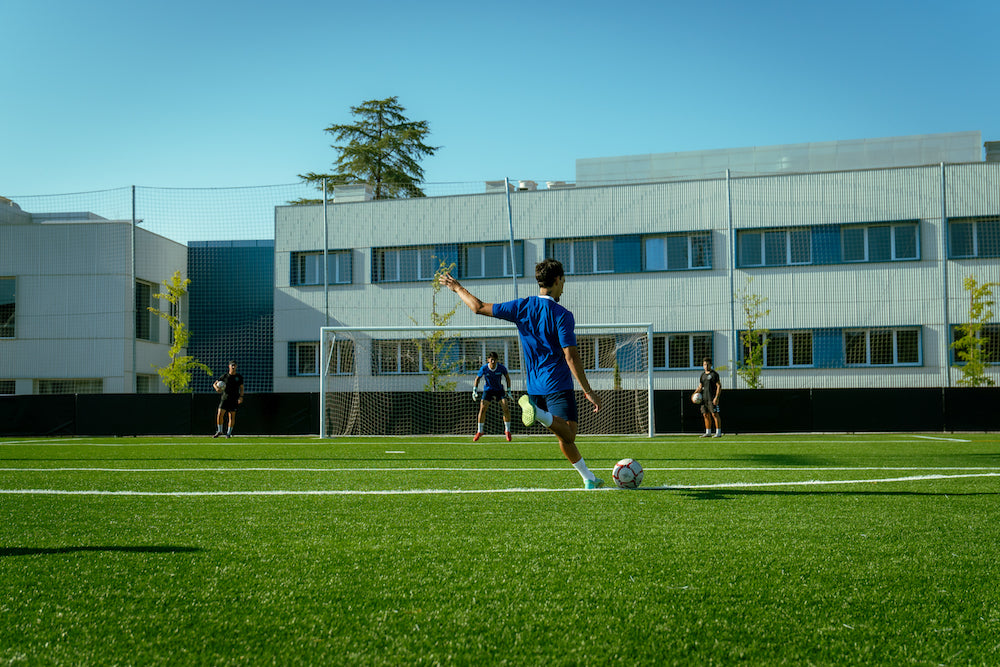


Choosing among youth soccer specialty programs in Houston can feel difficult when every option promises more training, more competition, or a faster path forward. The right choice starts with a simpler question: what does your player need next? GFI Academy offers focused opportunities for goalkeepers, athletes building mental performance, families looking for school-break training, competitive players developing as people, and older athletes exploring a pre-professional pathway.
Start with a free GFI youth soccer clinic if your family is still exploring the right entry point.
What are youth soccer specialty programs?
Youth soccer specialty programs are focused training or development experiences that address one part of a player's growth beyond regular team practice. They may build goalkeeper technique, mental skills, finishing, game understanding, leadership, or preparation for the next competitive level. A useful specialty program complements a player's main pathway instead of replacing age-appropriate team development.
That distinction matters for parents. A private session may help a player solve a specific technical problem. A camp may provide concentrated repetitions during a school break. Sports psychology may help an athlete turn preparation into more consistent decisions under pressure. The GFI Players of Life program connects competitive soccer with leadership, education, social responsibility, and personal growth.
GFI Academy's specialty options are designed to serve different needs across the player journey. Families can begin with a free clinic or Recreation, add focused training as a player develops, and explore Competitive, High Performance, or USL2 opportunities when the player's readiness and goals support that step.
Goalkeeper training in Houston for focused technical development
Goalkeeper training helps a player develop the technical, tactical, physical, and mental habits required for the position, including handling, positioning, shot-stopping, distribution, and communication. The best training is age-appropriate and individualized, because a developing keeper needs both reliable fundamentals and game context.
At GFI Academy, goalkeeper training is led by Eduardo D'Avino, Director of Goalkeeping. His documented background includes professional playing experience in Italy's Serie B and Serie C, NCAA Division II goalkeeping, and coaching work with MLS Next and USL Academy goalkeepers. The program uses a European-style approach tailored to each athlete's strengths and areas for growth.
Who may benefit from specialized goalkeeper work?
- A new goalkeeper: A player learning the position can build safe handling, set shape, footwork, and confidence before technique becomes a habit.
- A field player trying goal: Focused sessions can make the transition less overwhelming while introducing positioning, distribution, and decision-making.
- A competitive keeper: Targeted repetitions can sharpen reaction saves, crosses, 1v1 situations, and the first pass after a save.
- An advanced keeper: High-level coaching can connect technical execution with tactical reading, communication, and decisions made at game speed.
GFI offers individual sessions and small-group sessions. Individual training is listed at $100 per session or $350 for a four-session bundle. Group pricing varies by group size, from $130 per hour for two players to $325 per hour for five players. Families should confirm current availability and scheduling before registering, since specialized training times and locations can change.
Goalkeeper training works best when the player also receives meaningful team minutes. Parents should ask how the specialty work connects to the player's current team, what the coach is prioritizing, and how progress will be recognized in matches. The goal is not simply to collect difficult drills. It is to help the player see the game earlier, make better choices, and trust sound technique when the pressure rises.
See GFI Academy goalkeeper training options for the current program details.
Sports psychology for youth soccer players
Sports psychology gives youth soccer players practical tools for focus, confidence, goal setting, anxiety management, and decision-making. It is not a promise that an athlete will never feel nervous. It is a structured way to understand those feelings and practice responses that support performance, learning, and long-term wellbeing.
GFI Academy's sports psychology training is led by Luis Poblacion, a former professional player for Cruz Azul F.C. in Liga MX and a former Division 1 college player with bachelor's and master's degrees in mental performance. The service is available for athletes ages 9-19, from beginner through advanced levels, in one-on-one sessions held in person or through Zoom.
What can a mental performance session address?
- Short-term goals: Turning a broad aim such as "play better" into a behavior the player can practice this week.
- Game anxiety: Identifying fears and building a repeatable pre-game or in-game response.
- Focus and decisions: Practicing strategies that help a player stay connected to the next action rather than dwelling on a mistake.
- Long-term planning: Connecting daily habits with a player's academic, athletic, and personal goals.
- External pressures: Making space for school, home, team, and social factors that can affect an athlete's experience.
Sessions typically last 45-50 minutes. The published options include a $108 single session, a five-session bundle for $479, an eight-session bundle for $678, and an unlimited monthly option for $276. A free 25-minute consultation is also available. Parents are strongly encouraged to participate when appropriate, while the athlete helps determine how parent participation fits the session.
Parents should view mental performance as part of development, not as a reaction reserved for a crisis. A player who is healthy, motivated, and curious can use these tools proactively. Families should also choose language that protects the player's dignity. The objective is to help the athlete understand what is happening, develop usable strategies, and take ownership of the process.
Learn about GFI sports psychology training and the current consultation and session options.
Youth soccer camps in Houston for concentrated learning
Soccer camps can be a practical way to add focused training without asking a family to commit immediately to a new year-round team. A well-designed camp creates repeated opportunities to practice a theme, apply it in small-sided or game-realistic play, and meet coaches and players in a concentrated setting.
GFI Academy lists camps across The Woodlands, Grand Oaks, Central Houston, and Sugar Land. Options include beginner-friendly development camps, goalkeeper camps, identification camps, and specialty themes such as Striking and Finishing, X-Factor 1v1, Tiki Taka, and World Cup. Listed prices range from $90 to $300 depending on the camp type. Goalkeeper and High Performance Goalkeeper camps are listed at $300, while several identification camps are listed at $180.
How should a family choose a camp?
- Match the theme to the need: Select a goalkeeper camp for position-specific work, an ID camp for an appropriately aged player exploring a higher pathway, or a general development camp for broader repetitions.
- Check the age and level: A camp should challenge the player without turning the experience into an avoidable comparison with much older or more advanced athletes.
- Confirm the location: A shorter drive can make attendance and recovery easier, especially when the player is also participating in seasonal soccer.
- Ask what the player will do: Look for a balance of instruction, repetitions, decision-making, and game play rather than a schedule made only of lines and isolated drills.
- Plan the next step: After camp, decide whether the player needs another focused session, a free clinic, a player evaluation, or simply time to apply the learning with a team.
Camp participation does not automatically mean a player should move into a higher team tier. It is one useful observation point. The more valuable result is a clearer understanding of what the player enjoys, where the player is ready for challenge, and what kind of support should come next.
Review GFI Academy summer soccer camps for current themes, ages, locations, and registration details.
Players of Life: developing the whole player
The GFI Players of Life program extends development beyond the match. It is automatically included with competitive enrollment for GFI competitive players ages U7-U19, with no separate fee. The 12-year structure is organized into Rootscraft for U7-U10, Upper for U11-U14, and Senior for U15-U19.
The program's core idea is straightforward: a strong soccer environment should help a young person grow as an athlete and as a member of a family, school, and community. That makes Players of Life different from a clinic that addresses one isolated skill. It is a long-term framework that gives competitive families another way to evaluate progress.
The four Players of Life pillars
| Pillar | What it can develop |
|---|---|
| Soccer | Individual Development Plans and technical, tactical, mental, and physical growth. |
| Leadership | Responsibility, integrity, a growth mindset, and preparation to lead in practice and life. |
| Social Responsibility | Community service, fundraising challenges, and participation in the GFI Gives initiative. |
| Education | Life skills, nutrition, body care, and responsible social media habits. |
Progress is not left entirely to impressions. GFI describes Athlete Development Program reports at the end of each season, with evaluation across the program's subject areas. Players can also receive graduation pins after completing a sub-program, certificates at an annual ceremony, and recognition through a special awards night.
For parents, the practical question is whether the program aligns with the values they want reinforced at home. Families should ask how coaches describe the Individual Development Plan, how the player receives feedback, and how leadership or social responsibility becomes visible in the team's routine. Those conversations make a broad promise more useful and concrete.
Explore the GFI Players of Life program and its age-based development structure.
How do specialty programs fit the GFI Academy pathway?
Specialty programs work best when they are connected to the player's primary level, schedule, and goals. GFI Academy's broader pathway includes Recreation, Competitive, and High Performance soccer, with options for families at different stages. A player does not need to begin at the highest level to benefit from a focused experience.
| Family situation | Useful starting point | Specialty connection |
|---|---|---|
| New or returning player ages 4-14 | Recreation or a free youth soccer clinic | Use a camp to explore interests, including goalkeeper or general skill development. |
| Player ready for structured competition | Competitive evaluation and team placement | Players of Life adds leadership, education, social responsibility, and individual development. |
| Ambitious player ages 11-20 | High Performance evaluation | Use position training, sports psychology, camps, and showcase preparation to support the player's specific needs. |
| Older player exploring pre-professional soccer | USL2 tryout and pathway conversation | Combine match analysis, professional habits, and mental and physical preparation with experienced staff. |
GFI lists Recreation at $380 for a full seasonal payment or $395 through the payment plan, plus a separate $150 uniform kit. Competitive enrollment is listed from $1,950 to $2,550 annually, while High Performance ranges from $2,430 to $2,890 annually. Payment plans and financial aid are available, and the 10% family discount applies to families with three or more players. Uniforms are purchased separately through Soccer Post, so families should include that item in their planning.
These figures are program-specific and can change. Parents should use the linked program page and ask GFI to confirm current availability, schedules, placement, and total costs before registering. Transparent questions are part of choosing the right fit, not a sign that a family is less committed.
Compare GFI Recreation, review Competitive soccer, and learn about High Performance pathways.
USL2 soccer in Texas for the next stage of development
USL League Two is a pre-professional platform for older players who want a serious competitive environment while maintaining collegiate eligibility. It is not a shortcut or a guarantee of a professional contract. It is a setting where players can test their habits, compete against strong opposition, learn from experienced staff, and explore what the next stage of soccer demands.
GFI Academy's USL2 program is based at the GFI Performance Center in Spring. The program describes game filming and analysis, job and internship opportunities, professional pathway development, and access to a 20-acre facility with multiple fields, a clubhouse, fitness resources, and locker rooms. The listed tryout fee is $50.
For a player considering this option, the most useful preparation is specific. Ask about the expected age and playing profile, how selection works, what the season requires, how academics are protected, and what feedback a player receives after evaluation. A family should also discuss transportation, recovery, work or school commitments, and the player's willingness to accept honest coaching.
Visit the GFI Academy USL2 page for the current pathway and tryout information.
What should parents ask before choosing a specialty program?
A specialty program earns trust when it can explain what it does, who it serves, and how a family will know whether it is helping. Before paying or committing time, use the following questions in a conversation with the academy:
- What exact player need does this address? The answer should be more specific than "get better." It may be handling under pressure, confident decision-making, or a consistent pre-game routine.
- How is the player grouped or evaluated? Age, experience, position, and current level should shape the training environment.
- How does this connect to the player's team? A private session or camp should reinforce useful habits that the player can apply in team training and matches.
- What will the parent receive? Ask whether the program includes feedback, progress notes, reports, or a follow-up recommendation.
- What is included in the listed price? Confirm session length, package rules, uniform costs, registration fees, payment plans, and any separate travel or event costs.
- What is the next appropriate step? A responsible coach may recommend more training, a different group, a break, or a player evaluation. The right answer is the one that fits the evidence, not the one that creates the most urgency.
Parents should also watch the player's response. A useful specialty program can be demanding, but the athlete should understand the purpose of the work and have a safe way to ask questions. For younger players, enjoyment and confidence are meaningful outcomes. For older players, ownership, consistency, recovery, and decision-making matter alongside technical quality.
Where can Greater Houston families find GFI specialty programs?
GFI Academy serves families in The Woodlands, Grand Oaks, Central Houston, and Sugar Land. The GFI Performance Center is located at 27001 Lenze Road, Spring, TX 77389, and serves as an important home for games, high-performance activity, and the USL2 program. Exact specialty-program locations and schedules depend on the offering, so families should confirm them before making plans.
The location decision should include more than mileage. Consider the drive after school, traffic at the time of training, the player's recovery, sibling schedules, and whether the family can attend consistently. A slightly farther program may be worthwhile for a highly specific need, but consistency usually creates more value than an ambitious plan that the family cannot sustain.
GFI uses PlayMetrics for program registration and ongoing parent communication. Families can use the relevant program page to find the current registration route, then contact GFI with questions about fit, dates, and placement.
Talk with GFI Academy about the right specialty option before registering.
Frequently asked questions
What age should a player start goalkeeper training?
A player can begin position-specific goalkeeper work when the training is age-appropriate and the player is interested in learning the role. Younger players should build movement, coordination, handling, and confidence without being defined too early by one position. GFI's goalkeeper options should be matched to the player's age, experience, goals, and current team role.
How much does goalkeeper training cost at GFI Academy?
GFI lists individual goalkeeper training at $100 per session or $350 for a four-session bundle. Small-group pricing is listed from $130 per hour for two players to $325 per hour for five players. Families should confirm the current schedule, location, group size, and availability before booking.
What is sports psychology for youth soccer players?
Sports psychology is mental performance coaching that can help athletes set goals, manage fear and anxiety, improve focus, and make more consistent decisions during games. GFI lists one-on-one sessions for athletes ages 9-19, available in person or by Zoom, with a free 25-minute consultation option.
Are GFI soccer camps only for advanced players?
No. GFI lists a range of camps for different ages and purposes, including development camps, goalkeeper camps, and high-performance identification camps. Families should read the age and level guidance for each camp and choose an environment that will challenge the player without creating an unnecessary mismatch.
Is Players of Life a separate paid program?
Players of Life is automatically included with GFI competitive enrollment and does not have a separate fee. It is a long-term program for competitive players ages U7-U19 that combines soccer development with leadership, social responsibility, and education.
What is the GFI Academy USL2 pathway?
GFI Academy's USL2 program is a pre-professional men's soccer pathway for older players. It provides high-level competition, game filming and analysis, internship and job opportunities, and access to the GFI Performance Center. The listed tryout fee is $50, and current tryout details should be confirmed with GFI.
Choose the next useful step for your player
The best youth soccer specialty program in Houston is the one that solves a real development need while fitting the player's age, goals, schedule, and readiness. A goalkeeper may need position-specific repetitions. Another athlete may need a practical plan for managing pressure. A family may simply want a focused camp before deciding whether to pursue a more structured pathway.
GFI Academy gives Greater Houston families several ways to explore that next step, from a free youth soccer clinic and seasonal programs to goalkeeper training, sports psychology, camps, Players of Life, High Performance, and USL2. Review the relevant page, write down your questions, and contact the academy for current details. A clear conversation is the beginning of a development plan that can grow with the player.
Families planning for college pathways can also review GFI SportsRecruits information and ask how recruitment support fits the player's broader development plan.