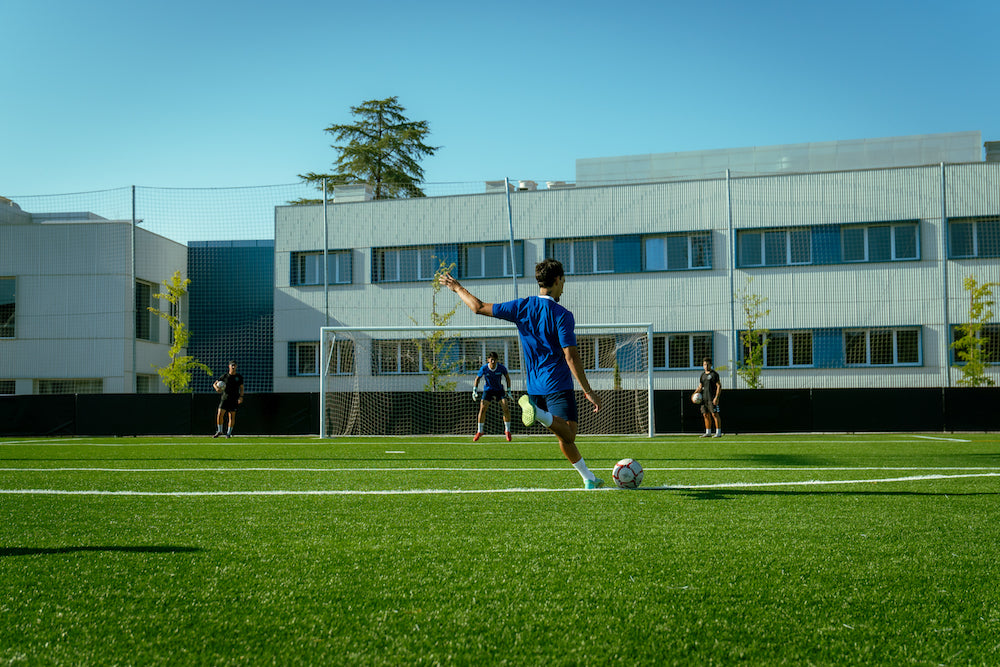


College soccer recruiting is not a single tryout or a last-minute email campaign. It is a gradual process of developing as a player, staying prepared academically, and learning which college environments fit the athlete and family. The strongest next step is usually a clear plan that connects training, competition, film, school research, and consistent communication.
To understand how to get recruited to play college soccer, focus on complete player development. Academic eligibility, quality video, thoughtful coach outreach, and the right opportunities to be evaluated. No club or showcase can guarantee a roster spot or scholarship, but a prepared player can make each season and conversation more productive.
Parents can support organization and decision-making while keeping the player active in the process. That starts with understanding when to begin, what college coaches evaluate, and how recruiting priorities change as a player progresses through high school.
When should high school soccer players start the college recruitment process?
There is no single recruiting age that guarantees the right result. A stronger approach is to treat recruitment as an ongoing process that develops alongside the player. The first steps can begin years before college, with attention to academics, technical growth. Healthy training habits, and a clearer understanding of what kind of college experience may fit.
In the early high school years, players and parents can focus on foundations rather than trying to force a decision. Keep track of coursework and grades, learn which academic standards may apply to different college pathways, and build consistent habits around training and recovery. The NCAA notes that academics are part of the recruiting decision, and its communication rules vary by division and grade level. Families should use current NCAA guidance rather than relying on informal timelines.
School research should also become more specific over time. A useful list considers the player's academic interests, location, campus environment, level of soccer, and overall fit. California Lutheran University recommends thinking about academics, location, and sports when visualizing college goals. That broader view helps a player avoid chasing a name that does not match their priorities.
Build evidence before increasing outreach
As a player moves through high school, maintain organized game information and begin preparing useful film. Coaches may watch games or review video, and sending a coach a relevant schedule and film link gives the coach a practical way to evaluate the player. Film should show decision-making, movement away from the ball, defensive work, and repeated actions in the player's position, not only goals or highlight moments.
Junior year is often a meaningful time to become more proactive with coach communication. But it should not be the first time a player thinks about fit, academics, or development. The NCAA also advises families to register early with the appropriate eligibility process to reduce delays and understand document requirements. Division I and Division II prospects should review whether an NCAA Eligibility Center certification account applies to their situation.
Q: Should parents start the process, or should players? A: Parents can guide organization and research early. The NCAA recommends that parents or guardians often lead in ninth and tenth grade, while students should take ownership and lead communication in eleventh and twelfth grade. That gradual handoff builds confidence without leaving the family to navigate important deadlines alone.
The goal is steady preparation: develop the player, protect academic options, research realistic schools, and make communication increasingly personal. That foundation supports a thoughtful answer to how to get recruited to play college soccer without promising a universal timeline or outcome.
What do college coaches look for in recruited players?
College coaches evaluate more than a player's highlight moments. They want to understand how an athlete performs within a team, responds to coaching, handles demanding situations, and fits the academic and soccer environment of the school. The process also varies by division and sport, so families should treat general guidance as a starting point and confirm current rules for each program. The NCAA explains that recruiting differs by division and sport.
Explicit answer: Coaches typically look for technical and tactical quality, smart decisions, physical readiness, academic preparation, character, coachability, consistency, and a realistic fit between the player and the program.
What coaches evaluate on the field
Technical quality includes the fundamentals that hold up under pressure: first touch, passing, receiving, ball striking, dribbling, defending, and finishing as appropriate for the position. Tactical quality is the ability to read the game, understand space, recognize threats, and contribute to the team's plan. A player who makes the right choice quickly can be more valuable than one who produces an occasional spectacular action.
Decision-making becomes clearest in full-game footage and live competition. Coaches want to see how a player behaves when the match is fast, when an early choice fails, and when the team must defend or adapt. Physical readiness matters too, including movement, speed, endurance, coordination, and the ability to repeat quality actions safely. It should be developed for the athlete's age, position, and stage of growth, not treated as a substitute for soccer intelligence.
- Technical execution that remains reliable under pressure.
- Tactical awareness, positioning, and decision-making within a team.
- Physical readiness appropriate to the player's position and development stage.
- Consistent effort and performance across matches, not only highlight plays.
- Coachability, communication, resilience, and respect for teammates.
Academics, character, and program fit
Academics are part of the recruiting decision, not an administrative detail. Grades, coursework, and eligibility planning can affect which opportunities remain open. The NCAA notes that academic and recruiting requirements vary, and its communication rules depend on division and grade level. Families should review official guidance early rather than rely on assumptions.
Fit works in both directions. Players should research a school's location, campus setting, majors, enrollment, team culture, and playing environment. Meredith College advises athletes to research those factors, attend camps or clinics when appropriate, send coaches schedules and video, and initiate contact with programs that genuinely interest them. That combination helps coaches evaluate the player and helps the player decide whether the program supports life beyond the field.
How to Get Recruited to Play College Soccer Through a Complete Profile
- Start with a clear player snapshot. Create one accurate document with the player's full name, graduation year, position, height, dominant foot, current team, contact information, and academic interests. Add a short description of playing strengths and development priorities, but keep it specific. A coach should quickly understand where the player competes, what role they play, and what kind of college environment they are exploring. The player should own the information while a parent helps keep it organized.
- Track academics as carefully as soccer. Record the high school, graduation date, current GPA, relevant coursework, transcript status, and intended major. NCAA eligibility requirements vary by division. For Division I prospects, the NCAA currently lists 16 approved core-course credits, required timing for ten of those courses, and a 2.3 minimum core-course GPA. Not every high school class counts as an approved core course, so review the current requirements with a school counselor and the NCAA Eligibility Center rather than relying on a general GPA alone. Division I and II prospects generally need an Academic and Athletics Certification account, while athletes still exploring options may begin with an NCAA Profile Page account. Early registration can help families understand documents and avoid preventable delays.
- Prepare useful film. Use recent game film that shows the player making decisions in realistic situations, not only isolated highlights. Identify the player clearly at the beginning and throughout the video when possible. Keep a short highlight reel for an initial introduction, then maintain full-game links that give coaches context about positioning, work rate, communication, and response after mistakes. Label links accurately, use stable permissions, and replace outdated film as the player's role changes.
- Publish the game schedule. List school and club events with dates, locations, opponents when available, team name, and the player's jersey number. Meredith College specifically advises prospects to send coaches game schedules and film links. Update the schedule when matches move, and send a concise correction rather than allowing a coach to arrive at the wrong field. GFI families may also review GFI's SportsRecruits platform as a recruitment resource. Treat the page as one possible place to organize recruiting information, and confirm its current instructions before assuming what it provides.
- Research schools for genuine fit. Build a balanced list based on academic programs, location, campus setting, enrollment, soccer level, roster needs, admissions expectations, and financial considerations. Research each program's coaching staff and recruiting process. The best list is not simply the most recognizable programs. It includes schools where the student's academic goals, playing profile, and preferred environment can reasonably align.
- Contact coaches directly and respectfully. Complete online recruiting forms for target colleges, then send a brief. Personalized email with the player's details, academic information, film, schedule, and a specific reason for contacting that program. NCAA communication rules vary by division and grade level, so verify the applicable rules before expecting a response. Guidance from NCAA and college athletics programs consistently encourages initiative, especially as students move into later high school years. The player should send or co-own the communication, follow up thoughtfully, and accept that no response is also an answer.
- Keep the profile current. Revisit the profile monthly and after meaningful changes to grades, position, team, schedule, film, contact information, or college preferences. A current profile makes every conversation more credible and helps the family make decisions from accurate information instead of last season's snapshot.
How league affiliations affect soccer recruitment visibility
League affiliation can influence the settings in which a player competes, trains, and may be evaluated. It can place athletes in particular competition and showcase contexts, but it does not replace the rest of the recruiting process. Coaches still consider a player's technical and tactical ability, decision-making, consistency, academics, communication, and fit for a specific program. For families learning how to get recruited to play college soccer, the useful question is not which label guarantees attention. It is whether the environment provides an appropriate level of challenge and opportunities for the player to demonstrate growth.
GFI Academy evaluates high-performance team placement through its coaching staff, with the stated goal of balancing challenge and success for long-term individual development. The programs below serve different player groups and should not be treated as a universal ranking.
| Program | Verified GFI description | Recruiting relevance |
|---|---|---|
| MLS Next | GFI describes MLS Next as its highest-level boys program within the High-Performance Pathway, for players born between 2012 and 2006. | Provides a high-level competitive setting where a player can continue developing and be seen in appropriate soccer contexts. It is not a guarantee of college recruitment. |
| Texas Next | GFI describes Texas Next as the second division of MLS Next for players born between 2012 and 2006. Athletes compete locally while training alongside MLS Next teams. | Offers local competition and a training environment connected to the broader pathway. The right fit depends on the athlete's current development needs. |
| DPL | GFI's DPL teams include girls born between 2012 and 2006 and compete against top girls academies regionally and nationally. GFI documents Spring and Winter Showcases, with possible Summit Event qualification. | Showcases can create additional evaluation settings, while performance during the season and consistent development remain important. |
| GA Aspire | GA Aspire is listed by GFI as one of its high-performance programs. | Families should ask GFI about current team availability, age-group fit, competition, and the development objectives for the specific player. |
Parents and players can review GFI's MLS Next player development pathway and GFI's DPL development pathway for program-specific information. Then compare the environment with the player's goals, school responsibilities, position, and readiness. A league name may open a door to a competition or showcase setting. But the player must still build a complete profile through development, academics, reliable communication, and purposeful outreach.
How GFI Academy supports college-bound players
Families asking how to get recruited to play college soccer need more than a list of showcases. They need a development environment that helps a player become more prepared, more self-aware, and better able to make informed choices. GFI Academy supports that process through a high-performance pathway, while keeping expectations realistic: no academy can guarantee a roster spot, scholarship, coach response, or recruiting outcome.
GFI's high-performance pathway includes MLS Next, Texas Next, DPL, GA Aspire, and Next Gen. The right placement depends on the player's age, ability, goals, and readiness for the demands of a particular environment. GFI says high-performance team placement is evaluated by its coaching staff to balance challenge and success for long-term individual development. That matters because the most visible league is not automatically the best fit for every athlete. Families can review the GFI high-performance pathway and compare it with the broader competitive soccer pathway for players.
Development comes before promotion
GFI's European-influenced Players Centric Methodology develops technical, tactical, physical, cognitive, and personal qualities. In practice, that means coaches are looking beyond a player's current speed or scoring record. They are also helping the athlete improve decisions, understand the game, respond to coaching, and build habits that can transfer to higher levels. Parents can read more about GFI's player-centered methodology before deciding whether its approach matches their family.
The coaching environment is another part of the support system. GFI documents coaches with UEFA Pro and US Soccer licenses, along with a staff of more than 70 coaches from more than 20 countries. Its 20-acre GFI Performance Center in Spring, Texas provides a dedicated setting for training and player development. These resources create opportunities for consistent feedback, but the player's daily effort, academic preparation, communication, and response to instruction still drive progress.
How families can make better pathway decisions
Players should take an active role in setting goals, tracking training priorities, organizing academic information, and learning how to communicate with colleges. Parents can provide structure by asking about school fit, finances, travel, workload, and eligibility requirements rather than treating recruitment as a race for exposure. A useful next step is to schedule a family conversation with a GFI coach, bring the player's recent questions and goals. And ask which development environment is appropriate now and what evidence would support a future move.
Frequently Asked Questions
How hard is it to get recruited for college soccer?
It is competitive, but a clear process improves your opportunities. Build a realistic school list, keep developing your technical and tactical game, maintain strong academics, create useful film, and contact coaches with specific information. Recruiting looks different at every division, so fit matters as much as visibility. No showcase, club level, or profile can guarantee a roster spot.
What soccer position is recruited most for college?
There is no single position that is always recruited most. Coaches recruit for the needs of their roster, so a player's technical quality, decision-making, athletic qualities, position-specific habits, and ability to contribute to the team's style all matter. Ask each program how it sees your position and what development areas would make you a stronger fit.
What GPA do you need to play Division I soccer?
For NCAA Division I initial eligibility, the current minimum core-course GPA is 2.3, along with required NCAA-approved coursework and other standards. Not every high school class counts as a core course. Requirements can change, so review the current NCAA Eligibility Center requirements and plan coursework with your school counselor.
When should a player start the recruiting process?
Start building the foundation early with academics, consistent development, and research into possible schools. Parents may help organize the process in ninth and tenth grade, while players should increasingly lead communication in eleventh and twelfth grade. Contact rules vary by division, sport, and grade level, so confirm the applicable recruiting calendar before expecting a coach to respond.
Do I need to play in a top league to be recruited?
Higher-level competition can create meaningful evaluation opportunities, but league name alone does not determine a player's college pathway. Coaches may assess game film, club participation, showcases, camps, academics, and direct outreach. Choose an environment that provides an appropriate level of challenge and supports steady long-term development rather than chasing a label without a plan.
Ready to Discuss Your Player's Next Step?
College soccer preparation is easier to navigate when a player's development goals, current level, and long-term pathway are considered together. GFI Academy can help your family explore an appropriate next step for a college-bound player without losing sight of growth on and off the field. Contact GFI Academy to discuss your player's goals and explore the right pathway.