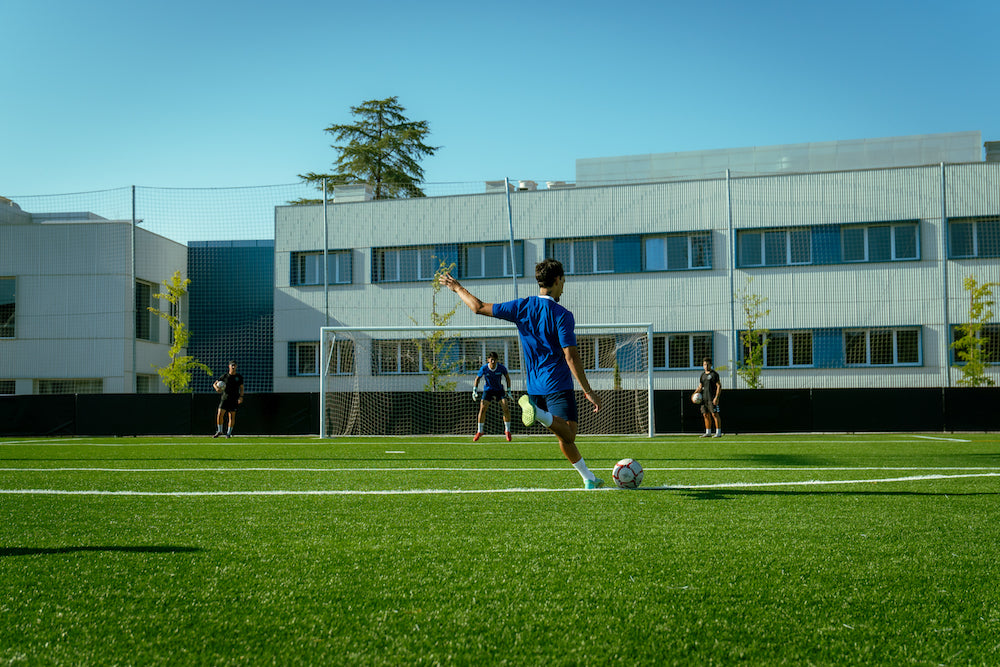


Strength training for soccer players is not about turning a young athlete into a bodybuilder. Done in an age-appropriate way, it helps players learn to control their bodies, move with balance, and build a foundation for the demands of practice and games. The right starting point depends on a player’s maturity, experience, and ability to follow coaching, not just their birthday. Families exploring soccer can contact GFI Academy to ask about a free clinic or no-fee tryout.
Ask GFI Academy about a clinic or tryout
What does strength training mean for a youth soccer player?
For young players, strength training can include bodyweight movements, balance work, jumping and landing practice, and, when a qualified adult is supervising, carefully taught resistance exercises. It is not a separate contest to lift the heaviest weight. The goal is to learn sound movement and gradually develop the physical qualities that support soccer: stability, coordination, strength, and the ability to control changes of direction.
Soccer already asks players to accelerate, stop, turn, shield the ball, and stay balanced while reacting to opponents. General strength work can complement those skills, but it does not replace soccer practice, sleep, enjoyable movement, or recovery. For children and teens, instruction and appropriate supervision matter more than complicated equipment or a demanding routine.
A review of resistance training among young athletes reports that supervised, age-appropriate training has a relatively low risk of injury. That is not a guarantee of safety in every setting; the quality of instruction, exercise selection, progression, and the individual athlete all matter. Families can read the review on resistance training among young athletes for additional context.
How should strength training change by age and development stage?
Age ranges below are broad guides, not strict cutoffs or a promise that every player is ready for the same exercise. A child’s coordination, interest, prior experience, and ability to understand directions should shape the starting point. If a player has pain, an injury, a health condition, or questions about whether exercise is appropriate, ask a qualified health professional before beginning or changing a training plan.
| Development stage | Main emphasis | Examples to consider | What adult support looks like |
|---|---|---|---|
| Younger players, roughly ages 4–7 | Enjoyable movement, balance, and coordination | Animal walks, gentle single-leg balance, hopping and stopping, playful climbing | Keep it brief and playful; demonstrate movements and prioritize a safe space |
| Developing players, roughly ages 8–12 | Movement control and basic bodyweight strength | Chair or box squats, incline push-ups, bridges, step-ups, controlled landing practice | Teach one or two cues at a time; adjust the exercise when form changes |
| Older teens, roughly ages 13–19 | Progressive strength with individual readiness in mind | Well-taught bodyweight or resistance exercises, single-leg control, trunk stability | Use a qualified coach to teach technique, choose progression, and monitor recovery |
What can younger players do safely?
For younger children, a formal gym routine is usually less important than varied movement and a positive introduction to being active. Play-based activities can develop coordination and body awareness without making training feel like a test. Short activities are often easier for children to follow than long sets of repetitive exercises.
- Balance: Stand on one foot briefly, then switch sides. Make it a game by asking the player to hold a comfortable position while a parent counts slowly.
- Hopping and landing: Hop a short distance, land softly with control, and pause before the next hop. Stop if the child becomes tired or loses control.
- Animal walks: Try a short bear crawl or crab walk across a clear space. Keep the distance easy and allow breaks.
- Climbing and playground play: Age-appropriate climbing and active play can challenge the body in varied ways. Follow the playground’s safety rules and supervise.
At this stage, praise effort, listening, and controlled movement rather than how many repetitions a child completes. If the child is no longer enjoying the activity or cannot follow the directions, switch to free play or finish for the day. Strength work should not become punishment for mistakes in a game or a way to pressure a child to specialize before they are ready.
What should players ages 8–12 learn first?
As children become more coordinated and able to follow instructions, they can practice simple movements with their own body weight. The first goal is to learn positions they can control: bending at the hips and knees, keeping balance, pushing with steady movement, and landing softly. Start with an easy variation that the player can perform well rather than making an exercise harder to look advanced.
A simple session might include a short warm-up, a few controlled repetitions of two or three movements, and an easy cooldown. For example, a player could practice chair squats, incline push-ups against a stable wall or bench, and glute bridges. An adult should show the movement first and watch the player throughout. This is an example for discussion, not an individualized program or medical prescription.
Keep the session short enough that the player can pay attention and maintain good control. Rest when needed. If an exercise causes pain, stop rather than asking the player to push through it. Avoid testing maximum lifts or copying routines designed for adults. Technique, confidence, and consistency are more useful foundations than a large exercise list.
When is resistance training appropriate for older teens?
Some teenagers may be ready to learn resistance exercises, but readiness is individual. A qualified coach should first check whether the player can follow directions, use controlled technique, and manage the exercise without rushing. Start with movements the athlete understands. Increase difficulty gradually only when the current version remains controlled.
That does not mean every teen needs weights. Bodyweight exercises and well-coached movement practice can remain useful. If equipment is introduced, a knowledgeable adult should select it, teach the athlete how to use it, and supervise the session. Avoid unsupervised lifting, competition to see who can lift the most, and training through pain or unusual fatigue. Parents should also consider the athlete’s overall schedule, including soccer practices, games, school, and other activities.
A teen who is returning from an injury or dealing with ongoing symptoms needs guidance from an appropriate health professional. A team coach may help coordinate general training, but should not diagnose or treat an injury unless qualified to do so.
Which movement patterns matter for soccer?
A balanced approach does not need dozens of exercises. Families can look for a mix of basic movement patterns, taught with control and adapted to the player’s ability:
- Squat and hinge: Practice bending at the hips and knees to build awareness of how to lower and rise with balance.
- Push: Use a suitable incline for push-ups, keeping the movement steady rather than forcing a difficult version.
- Trunk stability: Try a brief, comfortable front or side support if the player can hold a neutral, controlled position. Stop when the position breaks down.
- Single-leg balance: Practice standing on one leg or doing a low step-up with support nearby.
- Landing and changing direction: Rehearse small hops, soft landings, and stopping under control before adding speed or complexity.
These patterns connect to general athletic preparation, not a shortcut to better soccer performance. Players still need technical practice with the ball, tactical learning, and opportunities to make decisions in game-like settings. GFI describes its player-centered methodology as developing technical, tactical, physical, cognitive, and personal qualities together.
How can families balance strength work with soccer?
Strength work should fit around a young player’s life rather than crowding it out. Consider the full week: soccer sessions, games, school commitments, other sports, rest, and the player’s own energy. There is no single weekly plan that is right for every age and schedule. If the player is regularly exhausted, dreading training, or unable to recover between activities, talk with the relevant coaches and reassess the load.
Parents can help by asking practical questions: What is the purpose of this exercise? Who will teach and supervise it? How will the coach know when to make it harder? What should the player do if it hurts? A good answer should be clear and appropriate to the child. A supervised session should include time to learn and correct technique, not just a fast sequence of exercises.
Also make room for sleep, regular meals, hydration, and unstructured play. No strength routine can compensate for inadequate recovery. Families should not use a generic online plan as a substitute for an individualized assessment when a player has a health concern or injury history.
How does strength fit into a longer player pathway?
Physical development is one part of a broader soccer journey. A recreational player may be learning to enjoy the game and build basic coordination. A competitive player may take on more structured practices and matches. A high-performance athlete may face more demanding competition, but still needs training that reflects their age, experience, and recovery. The pathway should support the whole player, not treat every child as if they have the same goal.
Families can explore GFI Academy’s program overview, including Recreation and Competitive soccer. For older players and families considering an advanced environment, see the MLS Next, GA Aspire, and Texas Next program information. Program fit depends on the player and the family; no pathway guarantees a particular outcome.
GFI Academy’s Players of Life approach also reflects development beyond the field, with attention to leadership, responsibility, education, and personal growth. Those qualities matter in training, too: players learn to listen, stay patient while building a skill, and take responsibility for safe effort.
What should parents look for in a strength session?
Before a child starts a new program, ask who is supervising and whether that person has experience working with young athletes. Look for clear demonstrations, a safe space, equipment appropriate to the player, and gradual progress. The coach should be willing to modify or stop an exercise when the athlete cannot maintain control.
- The session begins with a clear explanation and a suitable warm-up.
- The coach emphasizes technique and control instead of lifting more or moving faster.
- The player can ask questions, rest, and report discomfort without being shamed.
- Exercises match the athlete’s experience and are progressed gradually.
- The adult considers the player’s other practices, games, and recovery needs.
Be cautious of programs that promise a specific performance outcome, push maximal lifting without preparation, or treat pain as something a player must ignore. A coach should not replace a clinician for injury evaluation or medical advice. When in doubt, pause and ask questions before continuing.
Contact GFI Academy with questions about your player’s next step
Frequently asked questions
Can children strength train before they are teenagers?
Children can practice age-appropriate strength and movement activities when instruction, supervision, and exercise choices suit their development. For younger players, playful bodyweight movement and balance are sensible starting points. The child should be able to follow directions and perform the movement with control.
Do young soccer players need to lift weights?
No. Strength training can include bodyweight exercises, balance, and controlled jumping and landing practice. If resistance equipment is considered for a teenager, it should be introduced and supervised by a qualified adult who can teach technique and adjust the exercise.
How often should a youth player do strength training?
There is no universal schedule for every player. Age, experience, soccer workload, other activities, and recovery all matter. Families should ask the coach how the work fits with the full weekly schedule and avoid adding sessions simply because a player wants to do more.
Should a player keep training if an exercise hurts?
No. Stop the painful movement and tell a parent or coach. For persistent pain, an injury, or a health concern, seek advice from an appropriate health professional rather than trying to diagnose it through a training plan.
Ready to explore the right next step?
Every player develops at a different pace. Start with safe movement, supportive coaching, and a plan that leaves room for school, soccer, rest, and enjoyment of the game.
When strength training is patient, supervised, and matched to the athlete, it can be one useful part of a thoughtful soccer development journey.