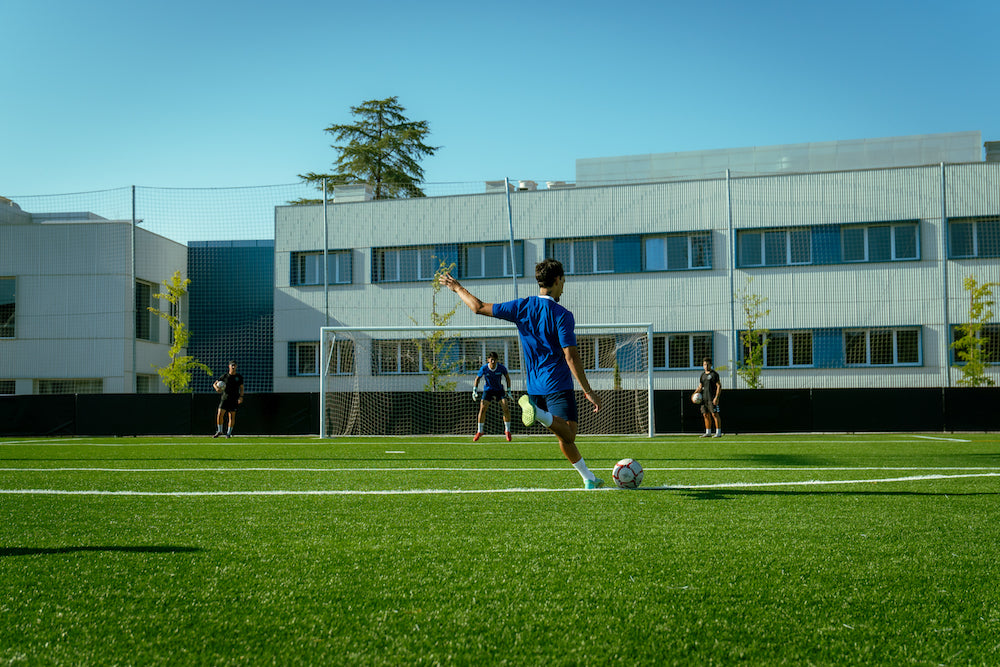


Soccer dribbling skills help young players keep the ball within reach, find space, and decide what to do when the game changes. Families can encourage those skills with brief practice that moves from comfortable touches to turns, choices, and light pressure. The aim is not to collect tricks. It is to help a player become more comfortable controlling the ball and choosing a useful next action.
Explore GFI Academy Competitive soccer
What do useful soccer dribbling skills look like?
Dribbling means moving with the ball while staying able to adjust direction, pace, or action. That includes several connected abilities: keeping the ball close enough to control, using either foot, changing direction without losing balance, and noticing what is happening around the player. A player may also need to decide when not to dribble. Passing to a teammate or protecting possession can be a better choice than carrying the ball into traffic.
For a young player, progress is more than speed or a long list of named moves. Look for small signs: they can slow down before a turn, use more than one part of the foot, look up briefly to find a route, or recover calmly after a loose touch. Children build these abilities at different rates. Give them time to repeat actions in a setting where mistakes are part of learning.
Technique should serve a purpose. A close touch can help in a crowded area, while a longer push may help the player move into open grass. A sharp turn can take the ball away from pressure. Asking a child to explain the choice in simple terms—“Where was the space?” or “Why did you turn?”—can connect movement with awareness without turning practice into a lecture.
How can a player keep the ball close?
Start in a safe, open area with a ball and a few visible markers. Invite the player to move slowly from one marker to another with gentle touches. The ball should remain close enough to reach in one or two steps. Avoid setting a target speed at first; a steady, balanced movement is more useful than racing after a ball that has run away.
- Use the inside and outside of either foot to guide the ball.
- Take smaller touches when moving slowly or entering a tighter space.
- Let the ball travel a little farther when accelerating into open space.
- Try both feet, but allow the player to pause and reset if the less-used foot feels unfamiliar.
- Glance up between touches to notice the next marker or an open path.
Keep the first round short. If the ball repeatedly gets too far ahead, reduce the pace or widen the route. If the player moves with ease, change one detail—perhaps the direction or the distance—rather than adding several new instructions at once. One clear cue, such as “soft touches” or “find the open gate,” is usually easier to use than a list of corrections.
Which turns help players change direction?
Turns let a player change the route while keeping the ball available for the next touch. Set two markers several steps apart. Have the player dribble toward one, turn around it, and return. Demonstrate slowly, then let them try at a pace that leaves enough time to stay balanced.
- Inside-foot turn: Use the inside of the foot to guide the ball across the body and back toward the route behind.
- Outside-foot turn: Use the outside of the foot to redirect the ball away from the body and into a new path.
- Sole stop and turn: Place the sole gently on top of the ball to stop it, then roll or guide it into a different direction.
- Pull-back turn: When approaching a marker, draw the ball back with the sole and turn the body to face the other way.
Ask the player to turn both directions. Do not expect the action to be fast or polished right away. First notice whether they can slow before the marker, keep the ball close during the turn, and continue moving afterward. If one version is awkward, make the route wider and practice it without timing the player.
How should practice progress from easy to challenging?
A useful progression changes one demand at a time. Start with room to move and no pressure. Then ask the player to choose a route, respond to a cue, or manage a partner nearby. If the activity becomes confusing, step back to the last version that felt manageable. The following stages offer a flexible guide, not a test that every child must pass on a particular schedule.
| Stage | Setup | Player's focus | Adjust when |
|---|---|---|---|
| 1. Familiar touches | Open space, no markers | Move, stop, and restart with either foot | The ball frequently travels beyond easy reach |
| 2. Follow a route | Two to four wide-spaced markers | Guide the ball around each marker | The route feels rushed or turns become unbalanced |
| 3. Choose a gate | Several wide gates made from cones or shoes | Look up and select an opening | The player can find a gate at a relaxed pace |
| 4. Respond to a cue | Open area and one spoken direction or color | Change speed or direction after the cue | The cue distracts from ball control too much |
| 5. Add a partner | One partner offering light, safe pressure | Protect the ball, turn, or move into space | The player feels hurried or no longer enjoys the task |
For example, a player who can dribble through a wide gate but loses the ball when asked to choose between two gates may not need a more complicated trick. They may need more time to look up or gates set farther apart. Once they can choose calmly, the family can vary which opening is available. This kind of adjustment keeps the practice focused on the skill that needs attention.
What are practical dribbling games for home?
Traffic lights
Call “green” for an easy dribble, “yellow” to slow down, and “red” to stop the ball. When stopping becomes comfortable, add a direction such as “turn left” or “turn back.” Keep the calls unpredictable but not so frequent that the player cannot respond. This game brings together listening, changing speed, and settling the ball.
Find the gate
Use shoes or cones to make two or three wide gates in a clear area. Call one gate and invite the player to dribble through it. Later, let them choose their own gate or ask them to look up before deciding. Leave enough space between openings for a turn, and move markers if the route crosses furniture, a driveway, or another hazard.
Shadow dribbling
A parent or sibling moves slowly through open space while the player follows with the ball. Make clear turns and changes of direction. The leader should leave room for the player to respond rather than darting away. Swap roles if the player enjoys leading; asking the child to choose the next direction can make the activity feel more like a game.
Treasure collection
Place several small, safe objects or markers around a playing area. The player dribbles to one, stops the ball nearby, and returns to a home marker before selecting another. Use a few objects at first, and let the player decide the route. The challenge is to keep the ball close while noticing where to go next, not to collect everything as quickly as possible.
How can players dribble with their head up?
Awareness develops in steps. First, ask the player to glance at a marker before reaching it. Next, place two wide gates in view and ask them to pick one before moving. A partner can hold up a color or point toward a direction while the player dribbles slowly. Keep the cue simple and give the child time to see it, decide, and act.
Do not demand that a beginner keep their eyes away from the ball constantly. The practical goal is to combine brief looks around with control, then gradually make those glances more frequent as comfort grows. In a game, simple questions can guide attention: Where is the open space? Is someone nearby? Is a teammate available? The answer can be to dribble, pass, turn, or shield the ball. All are valid decisions when they fit the moment.
Families seeking a broader coaching perspective can visit U.S. Soccer, the national governing body for the sport in the United States, and explore its soccer and coaching resources. Use any outside material as a general reference; a young player's activities should still fit their age, experience, available space, and coach's guidance.
How can families organize a short practice?
A simple session can feel purposeful without becoming a long training block. Set aside a clear area, check that the surface is suitable, and have water available. Choose one main focus—such as close touches or turning—then finish with a game the player likes. This sample sequence can be shortened or repeated based on interest:
- Settle in: Spend a few minutes moving freely with the ball. Invite the player to stop and restart, then try a few touches with each foot.
- Repeat one skill: Practice traveling to a marker and turning back. Start with a wide route and let the player choose the turn they want to try.
- Add a decision: Place two gates and call one only after the player begins moving. Keep the pace comfortable enough to notice the cue.
- Play a favorite game: Finish with traffic lights or shadow dribbling so the session ends with an enjoyable challenge.
- Reflect briefly: Ask what felt easy or what the player wants to try next time. A short conversation can help them notice their own progress.
There is no need to score every repetition. A parent might notice that the player used the left foot more often, slowed before turning, or remembered to look for a gate. Mention one specific observation and let the player enjoy the activity. If the child becomes tired, frustrated, or distracted, pause or stop rather than adding pressure to finish a planned number of rounds.
How should practice change with age and experience?
Young beginners often respond best to simple instructions, wide spaces, and chances to explore the ball without a fixed pattern. They may enjoy repeating a favorite game more than rotating through several drills. For a player who is ready for a little more, introduce one decision at a time: choose a gate, turn on a signal, or use the other foot for part of the route.
More experienced players may benefit from narrower gates, varied cues, or a partner who offers controlled pressure. The aim is still to create a problem the player can solve, not to make every repetition difficult. If success disappears entirely, ease the challenge. If the player completes the task comfortably, add a new choice or change the starting direction.
For families comparing development environments, GFI Academy offers Recreation, Competitive, and High Performance pathways in The Woodlands, Grand Oaks, Central Houston, and Sugar Land. Its Players Centric Methodology describes a player-centered approach that develops technical, tactical, physical, cognitive, and personal qualities. Families can review the Recreation program and the Competitive program to consider which setting may fit their child's interests and experience.
What should families look for in a soccer development program?
Ask how training connects individual technique with choices in play. A helpful setting gives players chances to try skills, notice options, and learn from mistakes. Families can also ask how coaches communicate with young players, how activities change with age and experience, and how the environment supports development beyond a single result.
GFI Academy serves Greater Houston families across four training locations. Parents can use the locations page to understand the areas served and learn about the GFI Performance Center. The academy overview offers more context about the club's approach. These pages can help a family form questions about schedule, fit, and development priorities before choosing a program.
For a player who is interested in a more competitive setting, families can review the GFI Academy tryout information. A tryout or program conversation is one way to learn what is expected; it does not replace an honest discussion about the player's goals, readiness, and enjoyment. The right next step should suit the child, not just the most ambitious option available.
Frequently asked questions
How often should a young player practice dribbling?
There is no one schedule that fits every child. Short, enjoyable practice can be repeated when the player is interested and has a safe space. Pay attention to energy and enthusiasm; a few focused minutes can be more useful than continuing after attention or comfort fades.
Does a player need special equipment?
A suitable soccer ball and a safe, open area are enough for the activities here. Cones are helpful but optional; visible household markers can make simple gates. Check the surroundings and surface first, and avoid practicing near roads, fragile objects, or other activity that could create a collision.
Should a child practice with both feet?
Yes, when it can be introduced comfortably. Invite the player to try each foot during easy activities, without expecting equal speed or control right away. Patient repetition gives them opportunities to become more comfortable on both sides.
What if my child loses the ball often?
Make the activity easier by slowing down, widening the gates, shortening the route, or returning to open-space touches. Losing the ball is a normal part of learning. Offer one useful cue at a time, and notice effort and recovery as well as successful touches.
Should a young player learn tricks before basic control?
Moves can be enjoyable, but they are most useful when a player can keep the ball close enough to try them and continue afterward. Build comfort with simple touches, turns, and changes of pace first. A move is a tool, not a requirement or a measure of a child's potential.
What should your family take away?
Strong soccer dribbling skills grow through age-appropriate chances to control the ball, turn, notice space, and make decisions. Keep practice safe and encouraging, adjust the challenge to the player, and let enjoyment remain part of the learning process.
Explore GFI Academy tryout information
With a ball, a little room, and supportive practice, young players can build skills that help them feel more at home in the game.