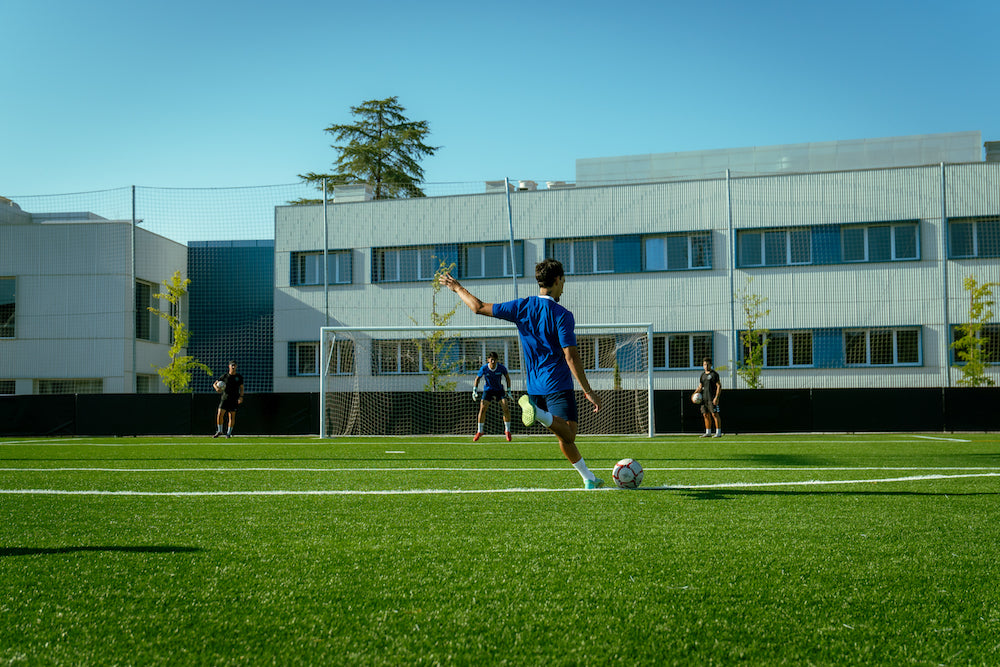


If your family is learning how to play soccer, begin with a warm-up that helps a young player move from everyday activity into the game. Keep it simple: start with comfortable movement, add familiar ball touches, then try a soccer action that asks the player to look and choose. The goal is readiness and confidence, not exhaustion.
Why does a soccer warm-up matter?
A warm-up gives players a little time to move, notice their surroundings, and focus on the activity ahead. It also gives a parent or coach a chance to check the playing space, equipment, and footwear. For children, it can feel like a game rather than a fitness test. Brief instructions and a quick demonstration often work better than a long explanation.
There is no one routine for every player. Someone new to soccer may need time to become comfortable moving with a ball. A player with more experience may be ready to pass, turn, and respond to a teammate. Adjust the challenge to the player’s age, experience, energy, and the session planned by the coach.
GFI Academy’s Players Centric Methodology considers technical, tactical, physical, cognitive, and personal qualities together. Families can learn about this player-centered development approach. A useful warm-up reflects that broad view: players move, handle the ball, look around, and make choices instead of waiting in a long line for one turn.
How should a player start moving?
Choose a clear area and begin with easy movement. Walk, jog gently, move sideways, or change direction at a comfortable pace. Keep the first actions controlled. The player should have enough room to move without colliding with others, equipment, or boundaries.
- Move in several directions: Walk or jog forward, sideways, and backward while keeping awareness of the space.
- Change pace gradually: Move slowly, pick up speed briefly, then slow down again.
- Practice stopping: On a signal, come to a balanced, controlled stop before starting again.
- Use open space: Look ahead and choose a clear path rather than following another player too closely.
For example, a parent can call “forward,” “sideways,” or “stop” while the child moves around a small area. Keep the directions predictable at first. If the player is comfortable, add a direction change or ask them to choose a route. The activity should stay relaxed enough for the child to listen and respond.
Stop if a player feels pain, becomes unwell, or seems unusually uncomfortable, and tell the responsible adult. A warm-up is not a way to diagnose or treat an injury. Follow the coach’s guidance and seek appropriate professional advice about health concerns.
How can players get comfortable with the ball?
When the player is moving comfortably, introduce the ball with simple touches. A beginner can look down, tap the ball gently, and regain balance. As control develops, encourage occasional glances up to notice open space. Avoid demanding perfect technique at the start; the point is to explore the ball while staying in motion.
- Dribble through open space. Use gentle touches with either foot and leave room to turn.
- Stop and restart. Bring the ball under control, look around, and continue in a different direction.
- Turn around a marker. Use a cone or other safe marker as a guide. Go around it at a manageable pace.
- Pass and receive. With a partner, pass a short distance, receive the return, then move to a clear space.
Make the activity playful when that helps the child participate. Call a color or direction and invite the player to guide the ball toward a matching marker. If the player misses the marker or loses the ball, offer another try rather than turning the moment into a contest. A warm-up should leave room for mistakes and adjustments.
Parents considering a first organized step can review GFI Academy’s Recreation program information. Families looking for a more structured competitive setting can explore the Competitive program. The right choice depends on the child’s interests, readiness, and family schedule, not on completing a particular warm-up drill.
How can a warm-up include soccer decisions?
After movement and ball familiarity, try an activity that resembles a small part of soccer. A player might pass, move to support a teammate, turn into open space, or respond to a simple signal. Keep the setup small so each child has frequent turns and a reason to pay attention.
- Set out two or three passing gates. A pair passes through one gate, then chooses a different gate for the next pass.
- Ask the player to move into a new open area after passing, instead of standing still to watch.
- Before receiving, invite the player to glance around and decide which direction to take the next touch.
- Use a small space with one clear aim, such as keeping the ball moving between teammates.
These choices introduce the idea that soccer involves more than running with the ball. Players look, communicate, find space, and respond to one another. Adults can encourage thinking with a question such as “Where is the open space?” rather than calling out every movement. GFI Academy’s program overview explains its broader development pathway.
Related products


What does a practical warm-up plan look like?
The example below is a flexible sequence, not a required schedule or test. The time for each part can change with the player’s age, experience, group size, and coach’s plan. For a new player, use fewer instructions and allow longer to explore. For a familiar group, move on when the activity feels comfortable and controlled.
| Part | Example | What it develops | How to adapt |
|---|---|---|---|
| Easy movement | Walk, jog gently, and change direction in open space | Awareness, balance, and gradual activity | Use fewer direction changes for a beginner |
| Ball familiarity | Dribble freely, stop the ball, and turn around a marker | Comfort and control with the ball | Enlarge the space and allow slower touches |
| Partner practice | Pass a short distance, then move to a new space | Passing, receiving, and movement after a pass | Shorten the distance or begin with a stationary partner |
| Game-like choice | Choose an open gate or respond to one direction | Looking up and making a simple decision | Offer two clear options rather than several |
To use the plan at home, prepare the space before inviting the child to start. Put away obstacles, choose a safe marker, and decide on one simple signal. Demonstrate the first action, then let the child try. If the player does not understand, show it again or reduce the task to one step. For instance, practice stopping the ball before asking them to stop and turn toward a gate.
At a team session, the coach’s plan takes priority. A group may use a passing activity rather than individual dribbling, or include fewer stages because players are arriving at different times. The location also matters: check the playing surface, weather, nearby activity, and equipment. A clear area and a manageable task make it easier for a young player to focus.
How should families adapt activities to age and experience?
Young players often respond well to short explanations, demonstrations, and activities that give everyone a chance to participate. A beginner may enjoy free dribbling and stopping the ball. A more experienced player may be ready to combine a pass, a direction change, and a decision about where to move next. Change one element at a time so it is clear what the player is practicing.
For example, if a child can dribble comfortably but loses control when asked to find a gate, first make the gate larger or reduce the number of choices. Once that feels manageable, add a second gate or ask the player to look up before turning. If partner passing is difficult, move closer or let the partner stop the ball before returning it. These small adjustments preserve the soccer idea while lowering unnecessary difficulty.
Rather than deciding readiness by age alone, notice how the child responds. Are they interested in trying again? Can they follow one simple direction? Do they seem comfortable with the group’s pace? These observations can support a practical discussion with a coach about what kind of setting may suit the player.
GFI Academy serves families through Recreation, Competitive, and High Performance pathways in The Woodlands, Grand Oaks, Central Houston, and Sugar Land. Families can review GFI Academy locations to consider what is convenient. For competitive tryout information, see the tryouts page; ask the academy which program is appropriate if you are unsure.
What warm-up habits should families avoid?
A warm-up should prepare a player to participate, not become a demanding workout. Avoid repeated all-out sprints before a child has had a chance to move gently. Avoid long lines when an activity can give more players a turn. And do not treat a mistake as a reason to remove the player from the activity; simplify the instruction or offer another opportunity.
It is also unhelpful to compare one child’s speed, coordination, or ball control with another’s. Players arrive with different experience and confidence. Focus instead on whether the child is engaged and able to try the activity. If a drill is confusing, make it simpler. If it feels easy, add one new challenge, such as a turn after a pass, rather than changing everything at once.
Families seeking general information about U.S. soccer and its player-development resources can visit U.S. Soccer. For academy-specific information, review GFI Academy’s about page or contact the academy through its published channels.
How can parents make practice feel encouraging?
Use feedback that describes an action the child can repeat. “You looked up before choosing a direction” tells the player what went well. “Try a softer touch as you turn” gives one useful next step. General praise can be warm, but specific observations help children connect effort with a decision or movement.
Give the player time to explore. If an adult corrects every touch, the child may focus on pleasing the adult instead of noticing the ball and space. Try asking a question after a short activity: “Which gate was easiest to reach?” or “What helped you keep the ball close?” Let the child answer in their own words, then choose one idea to try again.
For a group, make sure the setup offers repeated turns. If several players share one ball, create pairs or add another ball when practical. If children are waiting, give them a simple role, such as choosing the next gate, rather than leaving them idle. Keep competition optional; the warm-up can be successful when players are engaged and ready to practice, even without keeping score.
How can families think about the next soccer step?
A warm-up is only a small part of a player’s experience. Families comparing programs can consider the player’s enjoyment, the amount of structure they want, the travel required, and whether the schedule works for the household. A first season may be about learning basic actions and joining a group. A more experienced player may want a setting with a greater training and competition commitment.
Ask practical questions when speaking with an academy: What program is designed for this player’s age and experience? What should a family expect from the weekly commitment? How does the coach help a new player join in? What is the next step if the player wants a greater challenge? Clear answers help families compare options without assuming that every child needs the same pathway.
GFI Academy describes a pathway from Recreation through Competitive and High Performance. Its player-centered approach brings technical, tactical, physical, cognitive, and personal development together, with Players of Life emphasizing growth beyond the field. Families can use the methodology page and the locations page as starting points when considering fit.
Frequently asked questions
How long should a young player warm up?
Use a short, flexible routine that fits the child and the planned session. Start with comfortable movement, then add the ball and a simple soccer action. Follow the coach’s guidance rather than treating one duration as right for every player.
Can a beginner practice soccer alone?
A beginner can try simple movements and gentle ball touches with a responsible adult nearby. Choose a clear space and an activity that is easy to follow. Partner passing and team activities can be added when the player is ready.
What if my child finds a drill difficult?
Make one part easier. Enlarge the space, shorten the passing distance, or give the player just one direction to follow. Demonstrate again and let them try without pressure. Add complexity only when the basic action feels familiar.
Should a warm-up be competitive?
No. A playful challenge can engage some children, but keeping score is not necessary. Frequent turns, simple choices, and encouragement can help players prepare without comparing their ability with teammates.
What should your family take away?
When learning how to play soccer, young players can start with comfortable movement, add simple ball touches, and finish with an action that invites them to look, move, and choose. Keep the routine flexible, welcoming, and appropriate to the player in front of you so practice begins with confidence and room to grow.