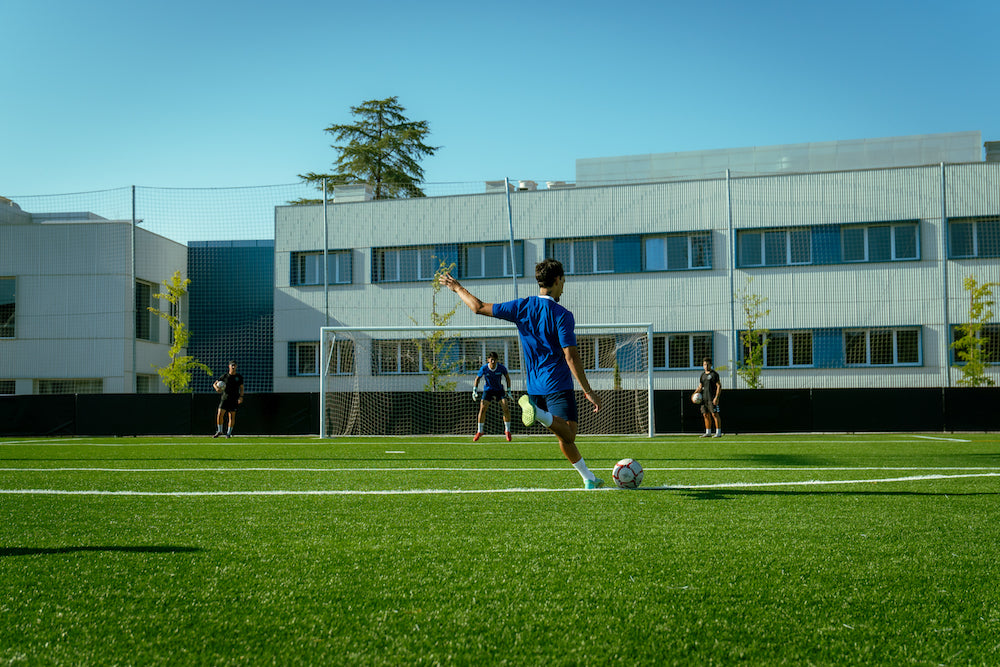


Competitive youth soccer asks players to do more than control the ball or memorize a position. They must use technique while reading teammates, opponents, space, and changing moments in a game. For families comparing programs, the key question is how training helps a player connect an action with the decision behind it. That connection can help parents recognize useful development and ask more specific questions about fit.
Explore GFI Academy Competitive soccer
What do technical and tactical development mean?
Technical development is how a player performs an action with the ball or body. Examples include receiving a pass, dribbling, turning, passing, striking, and defending with balance. A technique is not only a movement performed in isolation. The player needs to control it well enough to use it in a changing game.
Tactical development is how a player understands and responds to the game. It includes noticing open space, deciding when to support a teammate, moving after a pass, choosing when to press, and adapting when the first plan is unavailable. A tactical choice can be individual, such as finding a passing lane, or shared, such as a group moving together to defend.
The two areas influence each other. A player may see a useful pass but need more reliable technique to play it. Another may pass accurately in an unopposed drill but not yet recognize when a teammate is ready to receive. Development connects the movement, the information the player notices, and the choice made in response.
How do technical skills support game decisions?
Comfort with a skill can give a player more options. When receiving a pass becomes familiar, the player may have more attention available to check the field and consider what comes next. If the first touch carries the ball into pressure, even a promising idea can be difficult to carry out. Training can help players link a skill to the situation in which it matters.
Families can watch for progress without judging every action by whether it succeeds. Look for whether a player:
- Checks the field before receiving, rather than watching only the ball.
- Uses a first touch that leaves room to pass, turn, or dribble.
- Adjusts a pass for a teammate's position and the distance involved.
- Moves to offer support after passing instead of stopping to watch.
- Tries a solution again after a mistake, perhaps with a small adjustment.
These are observations, not a checklist every child must meet at once. Age, experience, confidence, position, and the demands of a particular game can affect what a player is ready to do. A young player may understand an idea during practice before using it consistently in a match. Progress can be uneven, so look for patterns over time rather than expecting each skill to advance at the same pace.
How can training connect technique with tactics?
Repetition can help a player become comfortable with a movement. It becomes more useful when the player also has to notice when and why to use it. A coach might begin with passing in pairs, then add a direction of play, a defender, or a choice between teammates. Each change gives the player new information to read before acting.
Consider a receiving activity that develops in stages:
- Build the action. The player receives a pass and keeps the first touch close enough to control.
- Add direction. A target or open side gives the player a reason to angle the touch rather than stop the ball automatically.
- Add information. A teammate offers one option while a defender applies light pressure. The player must look, choose, and execute.
- Change the picture. Vary the defender's position or the teammate's movement so the player cannot rely on one memorized answer.
- Reflect briefly. Ask what the player noticed and what other option might have worked. Keep the question open rather than supplying the answer immediately.
This progression joins technical action with perception and decision-making. It also lets players try solutions and learn from the result. If an activity is too easy, adding a choice or a little pressure may make it more game-like. If it is too difficult, simplifying the space or removing a defender can give the player another chance to succeed. The goal is a manageable challenge, not difficulty for its own sake.
What does tactical understanding look like on the field?
Tactical awareness does not begin with complicated formations. It can appear in simple habits: a player moves where a teammate can find them, recognizes that a defender is close, or recovers after possession changes. With experience, players can learn how one movement affects a teammate and how a group can create or close space together.
Imagine a player receiving the ball with an opponent approaching. A useful sequence is not always to dribble forward. The player might turn away from pressure, pass to a teammate in space, or protect the ball until support arrives. The right choice depends on the picture in that moment. Families can ask what the player saw, rather than treating one outcome as the only correct answer.
Team shape can also affect the decisions available. A player may have an easier forward pass when teammates spread out, while a compact defensive group may reduce the opponent's open lanes. A study of elite soccer competition examines how tactical formation relates to average and peak activity demands across positions and periods. It concerns elite match demands, not a youth training prescription, but it illustrates why tactical context can change what players are asked to do: research on tactical formation and activity demands in soccer.
When discussing a player's match, consider the decision around an action as well as the final result. Did the player notice an option? Did they try to support a teammate? Did they respond when the first plan was blocked? A constructive conversation focuses on what the player noticed and learned, rather than turning every match into a test of goals or wins.
How can families compare development approaches?
Program names and competition labels do not explain what a player does at training. Ask how sessions balance skill practice, decisions, team play, feedback, and appropriate challenge. GFI Academy describes its GFI Players Centric Methodology as a player-centered approach that develops technical, tactical, physical, cognitive, and personal qualities. Families can read the description and ask how that approach is reflected in the age group they are considering.
The table below can help organize a conversation with any program. A helpful answer gives concrete examples and clarifies what is specific to the player's age group rather than relying only on broad promises.
| What to compare | Questions to ask | What a clear answer might explain |
|---|---|---|
| Technical practice | How do players work on receiving, passing, dribbling, and finishing? | How skills are practiced and then used in realistic game situations. |
| Tactical learning | How do players learn to read space and make decisions? | How activities encourage observation, choices, support, and adaptation. |
| Coaching feedback | How do coaches respond when a player makes a mistake? | How feedback gives a player a useful next step while leaving room to try. |
| Player development | How are goals or progress discussed with players and families? | How the program considers learning over time, not only a match result. |
| Practical fit | What are the schedule, locations, age range, and costs? | Current details families can weigh against their own time and needs. |
Ask for information that applies to your child's age and experience. A program may serve several ages or offer more than one level, so do not assume every team has the same schedule, expectations, or development focus. It is reasonable to ask how communication works, who can answer questions, and what happens if a player's goals change.
Related products

How does development change with age and experience?
Young beginners benefit from plenty of contact with the ball, movement, simple choices, and a welcoming group environment. Activities can be organized while still feeling playful. At this stage, confidence and curiosity matter; players do not need to master advanced team concepts before they are ready.
As experience grows, training can introduce more pressure, quicker transitions, and more detailed team responsibilities. That does not mean development should become only about competition. Players still need chances to strengthen technique, understand decisions, build physical capacity appropriately, and grow as teammates. The right next challenge can differ from player to player, even within the same age group.
Families looking at pathways can start with GFI Academy's Recreation program information or its Competitive program information, depending on the player's interests and experience. Competitive is listed for ages 6–18; ask the academy for current, team-specific details rather than assuming one commitment fits every player. The academy's locations overview describes its Greater Houston footprint, including The Woodlands, Grand Oaks, Central Houston, and Sugar Land.
For girls exploring specific competitive pathways, families can review GFI Academy's information about DPL and GA Aspire. These program pages can help clarify the pathway being discussed, while a conversation with the academy can address a player's age, experience, and current options.
How can parents support learning after a match?
Parents can encourage reflection without becoming a second coach. Try one open question, such as “What did you notice when you had the ball?” or “When did you find space to help a teammate?” Give the player time to answer. If they are frustrated, listening first may be more useful than immediately correcting a touch or decision.
It can also help to notice effort and adaptability. A player who tries to receive on the far foot, looks for a passing lane, or keeps helping the team after losing the ball may be practicing useful habits even if the play does not end in a goal. Be specific about what you observed, and avoid comparing one child's progress with another's.
Questions about an individual training focus are best discussed with the coach, who can speak to the player's current work. Families can ask what one manageable next step might look like at home. A brief, low-pressure activity is often easier to sustain than a long list of corrections.
What can a player practice between team sessions?
Short, focused practice can complement team sessions when it is safe and enjoyable. A player might pass against a suitable wall or with a partner, receive with different surfaces, or dribble around a few simple markers. The purpose is not to copy a complicated routine. It is to gain comfort with the ball and enjoy trying something new.
Keep the activity simple, then vary one detail. After passing with the right foot, the player might try the left, change the distance, or receive and turn before passing back. A family can make a small game of counting controlled passes or choosing a direction after the first touch. Stop before fatigue or frustration takes over, and make sure the space and equipment are appropriate.
Home practice should not become a substitute for rest, school, family time, or other interests. Nor does a parent need to diagnose every technical issue. Encouragement, a safe opportunity to play, and genuine interest in what the child is learning can support development without adding pressure.
What should families ask before choosing competitive soccer?
Start by asking the player what they want from soccer now. One child may want to learn new skills and play with friends; another may be ready for more structured competition. Goals can change, so a conversation about fit should include the player as well as the parent.
- What age range and experience level does this team serve?
- How many training sessions and matches are expected, and where do they take place?
- How are technical skills connected to decisions in practice?
- How do coaches communicate a player's progress and areas to work on?
- What is included in the cost, and are any expenses separate?
- What might the next step be if the player's goals or needs change?
Ask for current details about schedules and costs rather than relying on assumptions or information from a different age group. Families considering a competitive next step can review GFI Academy tryout information and use it as a starting point for questions about the process. The page is the relevant route for learning about tryouts; it does not replace a conversation about an individual player's fit.
Frequently asked questions
Can technical and tactical skills be developed at the same time?
Yes. An activity can develop a movement while asking a player to notice space, teammates, or pressure. The challenge should suit the player's age and experience, and the player may need repeated chances to use the skill in different situations.
Does competitive soccer mean a player must specialize in one position?
Not necessarily. Position responsibilities can provide useful learning, but families can ask coaches how position choices relate to the player's current development and team needs. Avoid assuming that one position is the right long-term fit based on a short stretch of games.
How can I tell if my child is improving?
Look beyond goals and wins. A player may become more comfortable receiving the ball, notice options sooner, recover after losing possession, communicate with teammates, or respond constructively after a mistake. Development can be uneven, so look for patterns over time and discuss questions with the coach.
What if my child enjoys soccer but is unsure about a competitive commitment?
Talk together about what they enjoy and what they might want to try next. Compare the expected time, travel, and cost with your family's needs, then ask the program about an appropriate level of challenge. The next step should support the player's interest and well-being.
Learn about GFI Academy tryouts
What should your family take away?
Technical quality helps a player carry out an action; tactical understanding helps them choose an action that fits the game. Look for training that links the two, encourages thoughtful decisions, and supports growth beyond match results. When comparing programs, ask clear questions about coaching, development, logistics, and fit so your player can keep learning with confidence.
If your family is exploring a next step, review the current program information and ask GFI Academy which option best matches your player's age, experience, and goals.